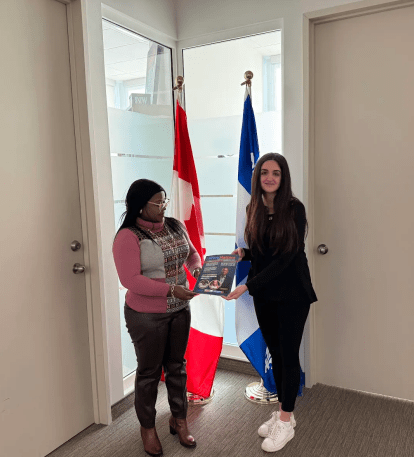

Member of Parliament Emmanuella Lambropolous: An ideal Politician Worth Admiring.
Born and raised in Saint-Laurent, MP Emmanuella Lambropoulos tirelessly worked in the field of education before beginning her political career, supporting students with learning difficulties and later becoming a teacher at LaurenHill Academy. Lambropoulos has deep roots in the community, serving as a member of parliament since 2017; with a deep understanding of the diversity of Saint-Laurent, creating jobs, supporting families and small businesses, and stimulating economic growth, among other services that impact the community, she has earned the trust of her constituency for a fourth term as a Member of Parliament (MP) for Saint Laurent in the 2025 Canadian elections with the Liberal Party.
With a background in teaching and a long history of social engagement, shortly before the elections she shared her inspiring story from the classroom to the House of Commons, her advocacy work, involvement in youth and mental health issues, and what motivates her to serve the people of Saint-Laurent. Blessing Umebali, the Publisher of Brandmatters Magazine and Media Consultant conducted an exclusive 35-minutes interview with MP Lambropolous, a woman of steel. Get inspired by her story as you read.
Prior to politics, did you have a career in a different field, or were you actively engaged in community service or advocacy?
I guess a mix of both. However, prior to politics, I was a teacher, and before becoming a full-time teacher, I was actually a resource aid. So, I was helping students with learning disabilities in the regular classroom, both of these I did at Lauren-Hill Academy, which is a school here in St. Laurent. As a teacher, I also held after-school activities; I coached different fields, like volleyball coach, dance coach, (Greek dance) to be precise. These were different ways that I got involved, and it was of course like extracurricular activities, which we weren’t paid for- it’s a way of rendering service. Also, within my community, I was very actively engaged throughout university days, and after I graduated from university, I was involved in an organisation called the ‘Maids of Athena’, which is part of AHEPA, and what we do is we raise funds for Children causes around the island of Montreal.
So, every year, we raise funds through our Annual Saint Valentine’s Ball for different children’s causes. This year’s Valentine’s Ball, we raised money to support Sainte- Justine’s Hospital Foundation to enable the foundation purchase a transcranial magnetic stimulation (TMS), basically for kids who were suffering from depression, anxiety, any kind of mental neurological disorder. Believe you me, this technology will solve the problem without doing a surgery, which is less damaging to the children. We do this, and lots of activities to support many families with the children causes.
“This year’s Valentine’s Ball, we raised money to support Sainte- Justine’s Hospital Foundation to enable the foundation purchase a transcranial magnetic stimulation (TMS), basically for kids who were suffering from depression, anxiety, any kind of mental neurological disorder. Believe you me, this technology will solve the problem without doing a surgery, which is less damaging to the children.”

Placing your educational background and your community service side by side, what really influenced your entry into politics most?
When comparing my educational background with my community service, I realize that my empathy has been the greatest influence on my entry into politics. I deeply feel for others, and whenever I interact with individuals or visit organizations dedicated to helping those in need, it profoundly moves me. I understand that many people are facing challenges that are more severe than what others experience. Witnessing any form of struggle, whether it’s difficulties in putting food on the table or issues related to mental health, reinforces my appreciation for the organizations that step in to offer free support to those in need.
As a Member of Parliament, one of my primary goals is to secure the necessary funding from the federal government for these organizations. I collaborate with them to identify the needs of the community so we can develop federal programs that effectively address these challenges. The more I engage with these issues, the more I recognize that numerous individuals require additional support to recover and maintain fulfilling lives.
Can you give some specifics, your success stories so far as a parliamentarian?
One of the significant achievements that has recently come to fruition is the National School Food Programme. Announced in the last federal budget, this initiative has allocated $1 billion to provide school lunches for 400,000 children. As the first Liberal Member of Parliament to introduce this bill, I was motivated by my experiences as a teacher, where I often witnessed students arriving at school without lunch. These children weren’t just expressing hunger or stating that they didn’t have food; many went as far as to hide in corridors or step outside during lunch hour to avoid drawing attention to their situation.
The embarrassment and shame associated with not having lunch can be overwhelming for them. Often, teachers remain unaware of which students are going hungry. To address this issue effectively, we need a comprehensive approach that encompasses the entire school. By providing meals for all students, we can ensure that every child has something to eat before they start their lessons. This was one way I aimed to make a difference, unfortunately, the Parliament was dissolved before my bill could advance in the previous session.
However, I continued to advocate for it, rallying support from my colleagues until we were able to successfully implement the National School Food Programme through a government bill. I am proud that my colleagues and I are making a real impact on the lives of so many children with this initiative. Top of Form
“One of the significant achievements that has recently come to fruition is the National School Food Programme. Announced in the last federal budget, this initiative has allocated $1 billion to provide school lunches for 400,000 children. As the first Liberal Member of Parliament to introduce this bill, I was motivated by my experiences as a teacher, where I often witnessed students arriving at school without lunch.”
What is the significance and how positive has it actually impacted your constituency?
Well, I think they appreciate having somebody who, first of all, is there to listen, wants to help them in whatever way they can. I am not just somebody who asks you to send an email and it ends there, no! I’m going to put you on a list, and we are going to find a way to give you food for the next couple of months. Like, there’s initiatives around the riding where we actually feed people. We have a food drive, and every Christmas time, we feed 120 to 150 families with boxes of non-perishable food items.
We work with Hope for Dementia, an organisation in the riding as well, that provides 100 fresh groceries, bags of fresh groceries to 100 families in the riding several times a year, and it’s the lists that we give them that they actually go and provide food for. So, we keep a list. My office runs an open-door policy, people come into our office and relate their problems and challenges and we listen and provide some kind of a tangible assistance to them, and we also direct them to organisations in the riding that can help them further.
What policies or legislative efforts have you actively supported or led, and how have they positively impacted your community or the people you represent?
One of the key areas I have been deeply involved in both as Women’s Caucus Chair and beyond, is women’s health, especially in the context of breast cancer screening. Women’s health is incredibly important to me, and I noticed a major issue with the direction we were heading when it came to screening guidelines. Specifically, the Federal Task Force on Preventative Health had recommended that the age for breast cancer screening be set at 50. This was a recommendation for all provinces, but I recognized that this was outdated. More and more women are being diagnosed with breast cancer in their 40s—and even in their 30s.
In fact, Black women tend to be diagnosed at a younger age, but this was not even considered in the research the Task Force was using. We fought hard to challenge that recommendation. We worked to ensure that more diverse populations were included in the research, so the guidelines could be more representative and better serve all women. This led to series of discussions with the then Minister of Health, Mark Holland; where we pushed for a review of the evidence and the Task Force’s procedure.
At one point, we even discussed the possibility of disbanding the Task Force due to their reluctance to update their approach. Ultimately, we were able to make a significant change; most provinces, after much advocacy, lowered the screening age to 40, which is a much-needed step forward for women’s health.
I would like to touch on something quite significant the $7.3 million investment you recently announced. It’s aimed at enhancing biodiversity, supporting career development, and more. What inspired this initiative, because it’s a major commitment?
Yes, well, what’s really remarkable about this initiative isn’t just the environmental benefit though, enhancing the biodiversity corridor is certainly important. The biggest and most immediate impact for my residents is that it will help mitigate flooding and prevent future flood events. Last summer, due to climate change, we experienced unprecedented rainfall. The ground simply couldn’t absorb any more water, and as a result, we saw flooding in areas that had never flooded before. In Saint-Laurent, some homes had basements completely filled with water. Many families were left devastated not only because their living spaces were destroyed, but also because insurance companies refused to cover the damages.
When we knocked on doors in September, we heard heartbreaking stories. People told us their home values had dropped. They had lost use of their basements some of them lived in those spaces and now they had to completely reorganize their lives. Many didn’t have the financial means to rebuild. They felt abandoned and hoped the federal government could step in. So, when I returned to our Quebec caucus meeting, I raised this as a top priority. I told my colleagues that the number one issue we faced in Saint-Laurent last summer was flooding.
And I emphasized that municipalities simply can’t handle this on their own, especially when insurance providers won’t help. We needed to find real solutions to prevent this from happening again. That’s why we pushed strongly when the municipal government applied for funding. We made sure their project received the necessary support, and that led to the $7.3 million investment. This funding will go a long way in protecting several areas from future flooding. Now, of course, some places like Norman Street have long-standing infrastructure issues that may not be fully addressed by this project. But overall, the majority of streets and neighbourhoods will benefit significantly from this investment through the biodiversity corridor.
So, how is the project coming along, has there been any progress yet?
The funding was just recently announced, so the project itself hasn’t started yet. It’s now up to the city to implement it, as it’s a municipal initiative. At the federal level, we don’t manage the execution of such projects. Our role is to support local applications whether from cities, organizations, or businesses and to advocate for funding when we believe a project will truly benefit the community. Aside from our own local initiatives, like the food basket program I mentioned earlier, we are limited in terms of launching federal-level programs directly. But what we can do, and what we have done is push hard to ensure these community-focused projects get the backing they need.
What steps have you taken in the areas of employment, affordable housing and what effects have those efforts had on the community?
It’s concerning to hear that many people are struggling with the high rates of unemployment. The Covid-19 pandemic has indeed exacerbated the issue, and it’s clear that the problem existed even before the pandemic. Fortunately, the government has taken significant steps to address the related issue of housing affordability. The national housing strategy, with an initial investment of $40 billion, aims to combat the shortage of affordable housing and homelessness, which has reached an all-time high in Canada.
In the local area, specifically in St. Laurent, there have been notable initiatives. For instance, the government announced funding of $6,760,000 for a project on Marcel-Laurin, which has resulted in 170 units, including 85 affordable units and 58 accessible housing units. This project is now complete, and people have started moving in this year.
Additionally, a more recent announcement was made in September last year, which will bring 110 more units to the area. These concrete actions demonstrate a commitment to addressing the housing needs of the community, and it’s heartening to see that people are already benefiting from these initiatives. We are currently exploring the optimal use of federal government lands, specifically a cluster of buildings in the area. Recently, we announced plans to repurpose the first building, located closest to our current location, into 110 units of affordable and accessible housing.
Furthermore, we are envisioning a broader community hub that incorporates multiple buildings. Our goal is to create a vibrant community space that not only provides affordable housing but also amenities such as a community centre and a local grocery store.
This is particularly important, as the area is currently underserved by grocery stores, making everyday essentials inaccessible to many residents. These two projects, which we have already announced, demonstrate our commitment to addressing the pressing need for affordable housing. While some residents are already occupying the newly created units, others will soon be able to move in, bringing much-needed relief to those struggling with rising housing costs. The escalating prices have been a significant burden, with annual increases of thousands of dollars, making it challenging for people to keep up. Our initiatives aim to mitigate this issue and provide a more stable and affordable living environment for the people.
What other support services or programme has your office been able to implement to assist the local families and seniors, or even the vulnerable populations in accessing and maintaining affordable housing also?
Our office cannot create programmes, because we are basically like the middleman between the people and the government. So, we are not able to create new programmes, unfortunately; but we try to remain as accessible and open to the public as possible. If anyone does have any suggestions for us, we take those suggestions and we bring them to the minister responsible for that plan. The ministers can, of course create a project or create a fund for something specific. Now, for seniors in particular, I try to make myself accessible to them, because I know it’s more difficult for them to come to the office. I go to their homes, talk to them and remind them of what services our office offers.
For the records, what our office offers are numerous, in the case of CRA; If anybody has a problem and not receiving the benefits they should be receiving when they file their taxes, or whatever it is, we can be the middleman. We just need an authorisation from the constituent to act on their behalf and we can go in and get information and basically make changes to their file according to what they want us to share with them. Also, in the case of immigration, if anyone wants us to see where things lie, they can speak to their member of parliament. Once they give us information to give to IRCC we will definitely do that for them.
If someone has a problem with a passport, or someone needs an emergency passport, be assured the next day that would be done. Basically, we run an open-door policy whereby anyone can have access to us for assistance. Thus, whatever programmes the government is offering, we make it easier and more accessible to our constituents. We have hundreds of people that we are currently helping at a time, and all of the cases that are open are for a different department within the government.
How difficult has it been for people to actually get their PR in Canada?
I think it’s; there’s a lot of backlogs for sure. There is a lot of files that people have had to go through because for a while, during the pandemic and after, a lot of people and a lot of companies were begging us to let people come from the outside because they couldn’t find workers. So, during that period when they couldn’t find any workers, we tried to help them save their business by allowing more people in, foreign workers to come into Canada and get passed. But of course, this created a huge log in the system.
And now, it’s like the unemployment rate has gone up and Canadians are looking for jobs and it’s more difficult. We are obviously limiting the number of people that we are allowing to come work from abroad. So that’s definitely been an issue, like work permits, we are not giving them often anymore because we are trying to prioritise Canadians that are not working and because we don’t have that need anymore.
And now we have a housing crisis because we allowed a lot of people in to work and save these businesses, but we didn’t have enough homes to actually be able to house them. So, of course you try to solve one problem and it creates a new problem and then you have to solve the new problem. But I think now we have limited our numbers for immigration, because of the fact that we are trying to get back on the track that we were before. Hopefully, this will help the backlogs go down as well; but more and more people might get refused because we are not accepting foreign workers as much.
“Basically, we run an open-door policy whereby anyone can have access to us for assistance. Thus, whatever programmes the government is offering, we make it easier and more accessible to our constituents. We have hundreds of people that we are currently helping at a time, and all of the cases that are open are for a different department within the government.”